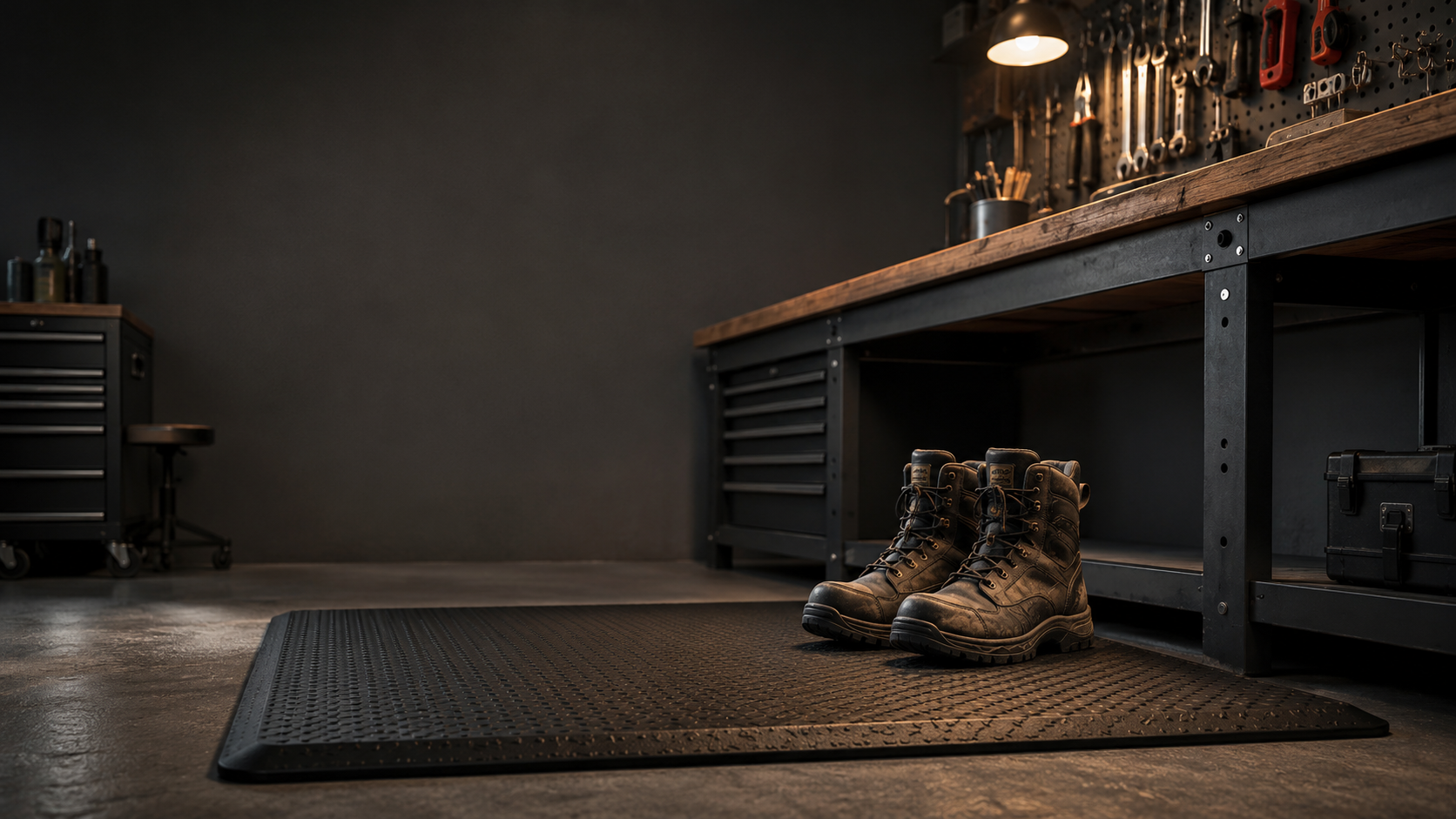
Anti-fatigue matting for workshops
Eight hours on a concrete workshop floor gets felt in the feet, the knees and the lower back. Most people reach for a thicker insole in their boots long before they think about the floor underneath them. An anti-fatigue mat is one of the tools for prolonged standing, not a magic fix. This guide sets out what a mat can realistically do, how to choose one by firmness, edge and resistance to whatever gets spilled on a workshop floor, and how much you need and where, sized by the workstation rather than by the floor area of the room.
What an anti-fatigue mat is, and what it can realistically do
An anti-fatigue mat is a cushioned floor covering for places where people work standing up. It takes some of the edge off a hard surface, so the body is not stood dead still on bare concrete. The best-supported point is a simple one: over a long stint of standing, a resilient surface feels less uncomfortable and less tiring than a hard floor.
It is worth being honest about how much can be promised here. A 2018 systematic review of ten studies found a moderate level of evidence that cushioned surfaces reduce discomfort and fatigue during prolonged standing, but the results varied enough that firmer conclusions cannot be drawn, and controlled work has found that some mats help while others do not. So "may reduce standing discomfort compared with a hard floor" holds up. Claims like "improves circulation" or "reduces pain" do not hold up without evidence for the specific product.
The mechanism most often cited is that a compliant surface allows small shifts in posture and a changing spread of load across the feet, rather than holding the body on a completely rigid base. That sounds reasonable, but it is not settled enough to sell "micro-movements improve circulation" as the single, proven reason mats work. The fairer thing to tell a buyer is this: reduced discomfort on a resilient surface is better established than any circulation story.
And the point that matters most for expectations: a mat on its own will not fix a workstation where someone stands for eight hours without moving. It works best when a resilient surface is combined with the chance to shift position, sit or lean now and then, a footrest, and suitable footwear. The sections that follow work through comfort, amount and layout, edge, slip resistance, liquids, wheeled traffic, ESD and cold, one at a time.
How a mat reduces the strain of standing
A hard floor gives nothing back, so the same muscles hold the same position for the whole shift. A resilient surface yields a little on each transfer of weight and springs back, so the calves and feet change position more often instead of standing locked. The benefit shows up late in the day rather than in the first hour: across a full workshop shift, less static loading means fewer aches carried home.
Flexadur's anti-fatigue mat delivers that give through 12 mm of rubber. That thickness sits within the usual range for industrial mats, but thickness is only the first measure, not the whole story. The same thickness feels completely different in dense solid rubber, cellular rubber, foam-backed rubber or heavily profiled rubber, so judge comfort together with firmness and construction, not by millimetres alone.
Can a mat be too soft or too hard
Softer and thicker is not automatically better. On foam that is too soft the ankles and lower-leg muscles work harder to hold balance, so a person stands unsteadily and feels like they are sinking in; a mat that is too hard or too thin is barely different from the concrete beneath it. The aim is a mat with enough give to take off the edge, but enough support that standing stays stable through the shift.
There is no universal ergonomics standard that sets one "correct" thickness. As a practical guide, industrial anti-fatigue mats are commonly around 10 to 20 mm thick, and published ergonomic studies have used mats of roughly 10, 15 and 19 mm. Treat 10 to 20 mm as a range for choosing, not a pass-or-fail rule, and weigh it together with firmness and construction.
Rubber hardness is reported using Shore durometer methods, which are useful for comparing compounds, but hardness alone does not tell you how comfortable the whole mat is, because deflection also depends on shape, ribs, bubbles, voids, foam layers and thickness. So do not compare two mats only by "12 mm" or only by "Shore A": a real comfort comparison needs both material firmness and the mat's construction.
How many mats, and what size
A common mistake is laying mats like wall-to-wall flooring. Do not cover the whole room. You place a mat by the workstation and the reach of the arms, not by the area of the room, because fatigue only builds where a person actually stands and works.
Start from the number of places where people work standing up, not from the floor area. Every bench, press, assembly point or inspection station that keeps someone on their feet needs its own mat; empty gangways need nothing. For a rectangular standing zone the mat covers its width and its depth of reach; where there are several separate stations, cover each one on its own and add extra only where people genuinely walk or turn. With modular tiles the number of tiles follows from the layout needed to cover the working reach, not from dividing the room area by the area of one tile.
A mat that is too small or badly placed forces one foot onto concrete and creates a lip right where the worker pivots, so part of the benefit is lost even when the material is good. Flexadur's anti-fatigue mat comes in a single size, so the question is purely coverage: for a wide bench, lay two mats side by side along the working edge so the worker stands on the mat across the full width of their reach. That targeted layout also keeps the floor safe, because the mats lie only where they are needed and carts and forklifts stay on the bare floor.
Edge, slip and keeping the mat in place
In a busy workshop the shape of the edge can matter as much as the cushioning. Sloped, bevelled edges are a recognised trip-control measure and carts roll over them more easily; a thick, square edge is more likely to catch a toe, a caster or a trolley wheel. A mat that curls, creeps or lifts its edges becomes a trip hazard; edges can be secured, but tape or adhesive is not a cure for everything, especially on oily, dusty or frequently washed concrete.
Slip resistance means something only alongside the stated test method and condition. EN 16165 describes several test methods for different conditions, and the standard itself warns that results from different methods are not directly comparable and that a dry result does not carry over to a wet or oily surface. For a workshop, what counts is what actually gets spilled on the floor, not a clean showroom: water, oil, coolant, dust and fine swarf change friction substantially. A mat that grips well when dry can become dangerous once oil gets onto it or under it, so texture has to come with prompt spill removal and regular cleaning.
Keeping a mat from moving depends most on a flat, clean floor, enough mass and friction in the mat itself, a good edge shape and, where it makes sense, an approved fixing. Dirt, oil or coolant under the mat turns the underside into a sliding layer even when the top is rough, so if only the top is cleaned the mat still travels. In oily and wet workshops it is especially important to lift the mat now and then and check the underside.
Oil, coolant and swarf: when "rubber" is not enough information
"Rubber" tells you nothing about chemical resistance. With oil, the type of rubber decides: NBR (nitrile rubber) is generally better where mineral oils, greases and petroleum-based fluids are expected, while NR and SBR are valued for mechanical properties and abrasion resistance but are generally not recommended for sustained contact with oils and hydrocarbons. How the rubber actually behaves still depends on the formulation, the fluid, its concentration, temperature and how long it is exposed. So oil or coolant can swell, soften or harden a mat that is otherwise fine for dry assembly, or weaken the material.
Laboratory methods such as ASTM D471 compare how liquids affect rubber, but a good result on one liquid does not mean resistance to every chemical in the workshop, nor does it grant a universal "oil-proof" label. On top of that, water-miscible coolants are chemically more complex than plain water: they can contain glycols, surfactants, corrosion inhibitors, biocides, amines and oils, so a compound that tolerates clean water or mineral oil alone may react differently to a particular concentrate. For machining, the safest question is not "is it rubber" but "is this compound compatible with coolant X at the expected concentration and temperature". Abrasion resistance is compared with methods like ISO 4649, and there too the standard warns that laboratory results are for comparison and do not directly predict how long a mat will last in service.
Where liquids get spilled on the floor, open-grid or drainage-hole mats make sense where contamination is expected, because they let liquid pass below the standing surface, but a mat does not replace real drainage. Holes only help if the water or coolant has somewhere to go and the area under the mat is cleaned too; a perforated mat sitting in a standing puddle is still standing in something wet and dirty. Holes can also move coarser swarf away from the shoe, but an open structure brings its own trade-offs: small chips lodge in the holes, sharp swarf stays underneath, narrow heels or casters drop in, and the underside has to be cleaned. In metalworking, "drainage" and "swarf management" are not the same problem; choose hole size and spacing by the real size of the chips and swarf, the footwear and the cart traffic.
Carts, ESD and cold
Constant cart traffic loads a mat differently from standing. Hard casters put high pressure on a small area and can catch on ribs, holes or sharp edges, so frequent cart crossings call for a lower, firmer mat with gentle bevels and a surface that does not grab wheels. Do not run forklifts across a soft comfort mat unless it is expressly intended and rated for that; a mat that copes well with shoes can fail quickly under a concentrated wheel load, or get in the way when driven over.
For electronics, mind the difference between the terms, because "anti-static", "ESD", "conductive" and "electrically insulating" are not the same thing. IEC 61340-5-1 sets the requirements for an electrostatic-discharge protection programme, and measuring floor resistance is part of it; an ESD workstation normally needs a whole system, the floor or mat, grounding, footwear or another way to ground the person, and verification. Ordinary rubber can be an insulator, so a comfortable, slip-resistant rubber mat can still break an ESD plan. And do not treat an ESD mat as protection against electric shock, or an insulating mat for work near live equipment as ESD protection; those are different hazards with different tests.
Cold changes rubber. As the temperature drops, rubber gets harder, and at a low enough temperature it can turn brittle, depending on the polymer and formulation; ISO 812 measures low-temperature brittleness, but warns that this is not automatically the lowest usable working temperature. A mat that is springy at 20 °C can feel noticeably harder in a cold workshop and crack more easily at the edge. Rubber softens the feel of standing on cold concrete because it conducts heat less readily, but "warmer underfoot" is not the same as a measured insulation value and should not be sold as one without testing.
Cleaning and replacement as part of safety
Cleaning is part of slip resistance: it removes contamination that would otherwise cause a fall, but the process itself can briefly leave the floor slippery, so the agent, method and drying have to suit the surface and the contamination. Cleaning agents can also damage rubber: solvents, strong oxidisers, fuels and some alkaline or acidic detergents can cause swelling, hardening, softening or cracking, depending on the compound. So the right maintenance routine depends on the compound, not on "any degreaser".
Finally, treat a workshop anti-fatigue mat as a consumable safety surface, not permanent flooring. It needs replacing when edges curl or tear, when there are cracks, permanent flattening, separated joints, worn-away texture, swelling, chemical softening or hardening, persistent movement or any damage that creates a place to trip. A mat can still feel comfortable after it has already failed as a safety surface, so when you inspect it look at the edge, the flatness, the grip, the state of the material and whether it can be cleaned, not just whether it is still soft.
Key takeaways
- An anti-fatigue mat can reduce standing discomfort compared with a hard floor, but it is only one ergonomic tool, not a circulation cure or a substitute for changing position, support and suitable footwear; it works best when a resilient surface is paired with the chance to move.
- Thickness is only the first measure. Flexadur's 12 mm rubber sits within the usual 10 to 20 mm range, but judge comfort together with firmness and construction; too soft makes standing unstable, too hard is barely different from concrete.
- Lay mats by workstation and reach, not by floor area, and with sloped edges so carts and toes do not catch; a mat that is too small forces a foot onto concrete right where the worker turns.
- "Rubber" is not a chemical-resistance spec: for oils and coolants ask for NBR or an explicitly oil-resistant compound and data for the actual fluid, and always read slip resistance alongside the stated method and real wet or oily conditions.
- For electronics, do not swap a documented ESD system (IEC 61340-5-1) for generic "anti-static" rubber, and in a cold workshop ask for a declared working temperature, because rubber stiffens in the cold. Confirm the exact properties of Flexadur's compound with the supplier.
Related resources
For the next step: the Anti-fatigue work mats page covers the 12 mm rubber, so you can match it to your bench and standing spots; check the compound-dependent data there too, such as oil resistance and working temperature. For the wider picture, browse Industrial and workplace flooring to see where an anti-fatigue mat fits alongside the rest of a workshop floor. If you are still scoping the project, All flooring buying guides group our advice by floor type, so you can compare anti-fatigue mats with tiles and rolls before you decide.
Ready to equip your workshop?
When your team works standing up, the floor under their feet is part of the job, not a side issue. Mats laid by the spots where people stand, with the right edge and the right compound for your fluids, are a small change that the feet and back feel by the end of the shift.