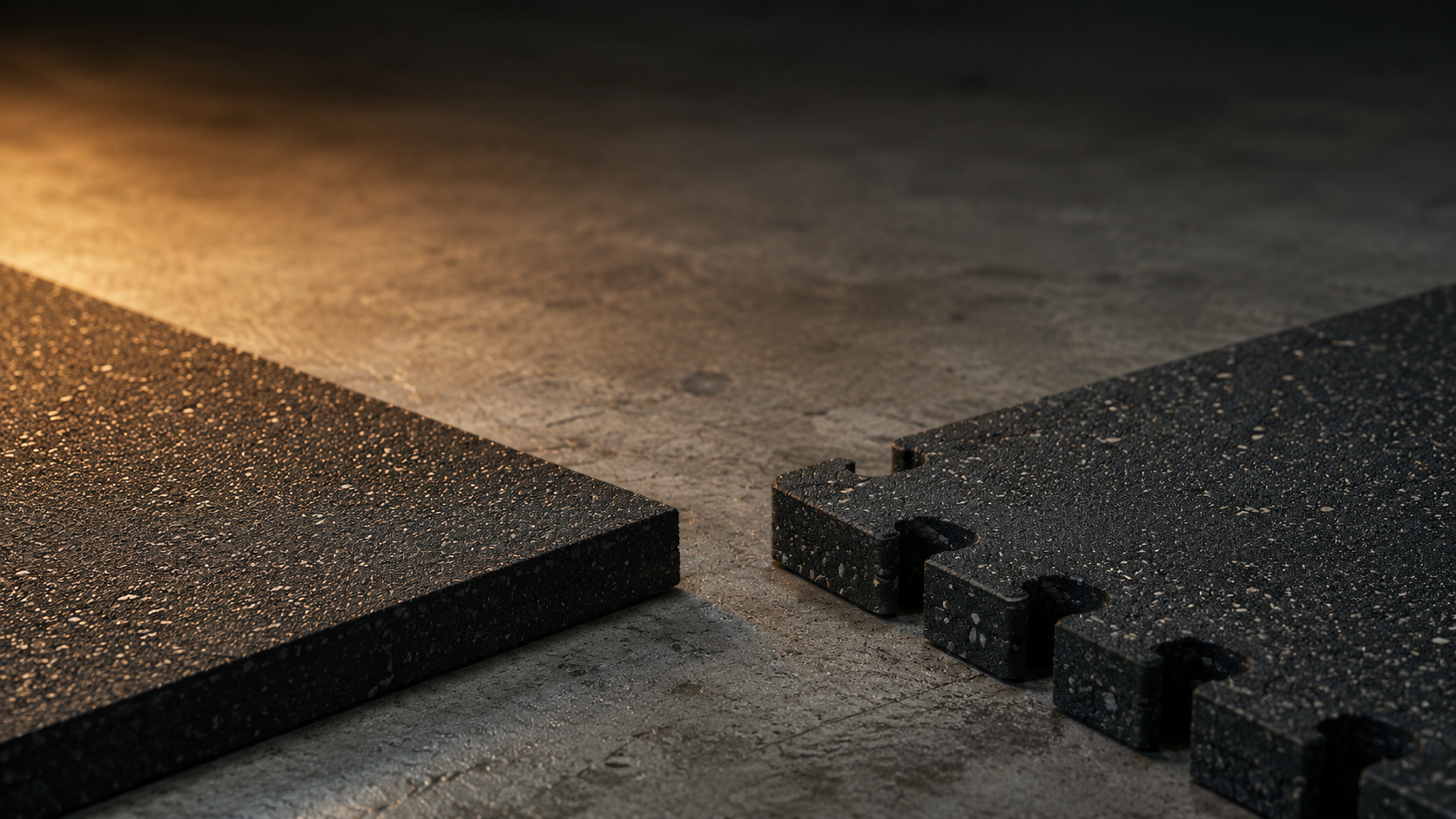
Straight-edge or interlocking rubber gym tiles: which should you choose?
Puzzle tiles and straight-edge tiles are both rubber gym tiles: both protect the subfloor, cushion dropped weights, and both come from the Flexadur core range. The difference is in the edge — the joint — and that changes how the tiles hold together, how they are laid, how easily they lift, and how they are repaired. It does not change the quality of the material. A puzzle edge mechanically bites into the neighbouring tile, so the tiles hold together even without adhesive. A butt joint has no such grip: straight-edge tiles meet edge to edge, held by tight alignment, their own weight and, in a permanent installation, adhesive. That is the real difference between the two formats — not the thickness and not the look.
The short answer
| Straight-edge rubber gym tiles | Interlocking rubber gym tiles | |
|---|---|---|
| Dimensions | 1000 × 1000 × 15 mm | 485 × 485 × 10 mm |
| Material | Rubber | Rubber |
| Colour | Black with white flecks | Black with blue flecks |
| Joint type | Butt joint of straight edges | Mechanical puzzle joint |
| Installation | Alignment; permanent lay usually bonded | Clicks together, usually no adhesive |
| Lifting and rearranging | Possible, with re-alignment | Fast, they unclip |
| Unit of measure | Piece (= 1 m²) | Piece |
| Minimum quantity | 1 tile | 1 tile |
Feature-by-feature comparison
| Criterion | Straight edge | Puzzle edge |
|---|---|---|
| Joint type | Butt, no mechanical grip | Puzzle teeth bite mechanically |
| Adhesive | Permanent lay usually bonded | Usually loose, no adhesive |
| Install speed | Slower: alignment and adhesive cure | Faster: the edges self-register |
| Lifting and reuse | Possible, needs re-alignment | Easy, the tiles are reused |
| Single-tile replacement | Cut or lift out, and strip the old adhesive if bonded | Unclip and join a new one |
| Seam appearance | Straight line; can be very tight | Puzzle line; precision-cut, it can be nearly invisible |
| Stability under rolling | High when properly bonded | Good between tiles; the whole field shifts if the perimeter is unrestrained |
Edge and joint: what each one actually does
The edge is the main difference, so start with what it does mechanically. Puzzle teeth engage one another, so two tiles have to deform or pull apart before the joint can open; that gives a local grip against lateral movement under footwork, pivots and shear. A butt joint has no such grip: straight edges only bear against each other, so straight-edge tiles resist separation through friction, a restrained perimeter, tape or adhesive.
That is why puzzle tiles hold together even without adhesive, while straight-edge tiles in a permanent lay usually need adhesive to stay just as still. That is the heart of the choice: you buy the puzzle edge for a grip without adhesive, and the straight edge for a clean joint that you usually fix by gluing.
Adhesive, loose laying and cure time
Puzzle tiles are most often loose-laid, without adhesive: the edges self-register, so one person can floor a room with few tools and a sharp knife, and the floor is in use straight away. Straight-edge tiles for a permanent floor are usually glued, and that adds steps: chalking lines, spreading adhesive, laying while the adhesive is still fresh, rolling and pressing, and cure time. Until the adhesive cures, the floor needs protecting from traffic and rolling loads, or the tiles shift, peak or indent.
A loose-laid puzzle floor has no such wait, but a bonded straight-edge floor becomes very stable once cured. You trade a shorter install for later strength, or the other way round. Whether loose-laying the puzzle tiles and gluing the straight-edge tiles suits your case, and which adhesive to use, confirm with the supplier — especially for a heavy-duty or permanent installation.
Stability: loose puzzle versus bonded straight edge
Here is where the most common misconception hides. "Puzzle is more stable" holds only while you compare a loose puzzle floor with a loose straight-edge floor. As soon as you glue the straight edge down, each tile is restrained over its whole underside, not only at the edges, so a well-bonded straight-edge floor can take repeated rolling, turning and lateral loads better than a loose-laid puzzle floor.
The puzzle edge, moreover, holds the tiles to one another but does not anchor the whole surface to the floor. Under strong, repeated lateral forces a loose puzzle floor can migrate as a single field and creep away from the wall if the perimeter is not restrained. That is why large loose installations often need edge treatment, a wall trim or another perimeter-restraint detail specified by the manufacturer.
The edge does not determine thickness or durability
The edge is a joint shape, not a marker of thickness, durability or rubber grade. That the straight edge here is 15 mm and the puzzle 10 mm is true of these two Flexadur products, not a rule; the thicknesses of the two formats otherwise overlap heavily.
A thicker tile gives more material to deform under impact, but thickness alone is no guarantee of protection from a dropped weight, because density, hardness, binder and construction all change the response. For regular drops of a heavy barbell, look for verified impact data for the specific product and, if needed, a dedicated thicker zone — do not choose by the edge or by the millimetres alone. Confirm the impact data for Flexadur tiles with the supplier.
Seams, liquids and the subfloor
Every tiled floor has more joints than a continuous roll, and a joint collects fine dirt and admits liquid if it opens. A puzzle joint has a longer path than a straight one, but a precision-cut puzzle seam can still be very tight; treat neither a butt joint nor a puzzle joint as waterproof unless it is explicitly built with sealing. In spaces with frequent wet cleaning, distinguish "rubber is water-resistant" from "the floor assembly is waterproof".
Neither format forgives a poor subfloor. Both need a firm, flat, clean and dry base; on an uneven base loose puzzle tiles rock and work at the joints, while bonded straight-edge tiles telegraph the irregularities or lose their bond. Rubber also changes dimension with temperature, so tight joints on install day do not guarantee tight joints later if the material and the room were not acclimatised — hence joints that later gap or peak.
Repair, lifting and reuse
Both formats let you replace a single damaged square instead of the whole surface, but not equally easily. A loose puzzle tile you unclip from its neighbour and drop a new one in; a tile in the middle of a tightly locked field calls for the neighbours to be flexed slightly or briefly disengaged. A bonded straight-edge tile has to be cut or lifted out, the old adhesive removed, new adhesive applied, and the joints held until they bond — more work.
Loose puzzle tiles are also easier to lift, move, store and reuse because there is no cured adhesive to break; that suits renters, temporary gyms and spaces that later expand or get rearranged. Keep a few spare tiles from the same batch, because the rubber shade and the fleck pattern can vary slightly between production runs.
Perimeter treatment and safety
The puzzle teeth on the outer edge are not a finished walking edge: they are usually not left exposed, but closed off with a border piece, a trimmed straight edge or a ramp. A straight edge is likewise cut to the wall and finished with skirting, a transition strip or a ramp. Where the floor steps down to a lower adjacent surface, a ramp or transition strip removes the abrupt threshold and lowers the risk of catching a foot — and that applies to both formats.
Whether Flexadur offers dedicated border and corner pieces or the perimeter is trimmed on site, and which ramps suit which thickness, confirm with the supplier.
Cost and coverage planning
Plan the coverage before you order, so you buy it all at once. Measure the room in metres, length and width, and add roughly ten percent for cutting, waste and a couple of spare tiles. Straight-edge tiles sell by the piece, and each piece covers one square metre, so the tile count is close to your area in m². Puzzle tiles are 485 × 485 mm, so each one covers a little under a quarter of a square metre; divide your area by the per-tile coverage and add the same ten percent for cuts and spares. With gluing, the adhesive, the subfloor prep and the labour also enter the cost, so compare the formats as a total installed price, not by the sticker price.
Not sure about thickness? Read how to choose gym flooring first, then come back to plan the coverage.
Straight-edge rubber gym tiles: a closer look
Straight-edge rubber gym tiles are 1 m² rubber pieces that butt-join edge to edge (1000 × 1000 × 15 mm), black with white flecks. They are meant for a permanent, usually bonded installation where the floor stays put and a clean joint and stability under rolling equipment come first.
What it does well:
- Bonded, each tile restrained over its whole underside — a stable floor for rolling and laterally loaded use
- A clean butt joint with few visible seams; each piece covers exactly 1 m²
Where it falls short:
- Needs careful alignment, and a permanent lay usually needs adhesive with a cure time
- Replacing a single tile is more work once it is bonded
Best for: permanent, bonded floors that stay put and have to take rolling equipment.
Interlocking rubber gym tiles: a closer look
Interlocking rubber gym tiles are 485 × 485 × 10 mm rubber tiles with puzzle edges that join without adhesive, black with blue flecks. They suit a fast solo install that can later be lifted and rearranged.
What it does well:
- The puzzle edge holds the tiles together without adhesive; a fast one-person install, in use straight away
- They lift, move and reuse without stripping adhesive
Where it falls short:
- A loose-laid field can migrate under strong lateral forces if the perimeter is not restrained
- The thinner 10 mm profile of these two products, and a more visible puzzle line where the colours contrast
Best for: fast solo installs and floors that may be lifted or rearranged.
The final verdict
Choose interlocking tiles when a fast adhesive-free install, solo laying and later rearranging matter most — for renters, garage gyms and dual-purpose spaces.
Choose straight-edge tiles for a permanent floor that stays put: bonded, it gives a stable, clean surface that takes rolling equipment well.
And if you are unsure, the real comparison is not edge against edge but how you lay the floor. A loose floor that might move wants the puzzle; a bonded, permanent floor is well served by the straight edge, and can even be more stable because each tile is restrained over its whole face. For regular drops of a heavy barbell, neither of these two formats is a dedicated 20–40 mm lifting platform; handle such a zone separately and confirm suitability with the supplier.
For softer work — throws and ground techniques — look at the EVA puzzle tatami mats rather than rubber tiles. For very large continuous areas, also consider a rolled gym rubber mat, which gives fewer seams across a big floor.
Both tiles show prices with and without VAT on their product pages and ship from the Flexadur warehouse in Croatia.


Frequently asked questions
Are interlocking tiles more stable than straight-edge tiles?
Not always. A loose puzzle floor holds better than a loose straight-edge floor because the puzzle teeth mechanically join neighbouring tiles. But a well-bonded straight-edge floor can take rolling and lateral loads better because each tile is restrained over its whole underside. Compare a loose puzzle with a bonded straight edge, not edge with edge.
Do interlocking tiles hold without adhesive?
Yes, the puzzle edge holds them together mechanically without adhesive, so they are most often loose-laid. A large loose-laid field can still migrate as a single unit under strong lateral forces, so the perimeter then needs restraining. Whether loose laying suits your loads, confirm with the supplier.
Which is easier to install on your own?
The interlocking tiles. The edges self-register, so one person can floor a room with few tools and it is in use straight away. Straight-edge tiles need a true starting line and careful alignment, and a permanent lay is usually glued, with a cure time before use.
Will the puzzle joints open when the temperature changes?
They can, if the material and the room were not acclimatised before installation. Rubber changes dimension with temperature, so tight joints on laying day do not guarantee tight joints later. The same applies to the butt joints of straight-edge tiles.
Which edge looks cleaner once the floor is finished?
A straight edge gives a simple straight line, but a precision-cut puzzle seam can be nearly invisible. The puzzle line shows more strongly where the colours contrast or where the joint is slightly open. "Puzzle always looks cheap" is not a reliable rule — compare samples.
Can I lift and reuse the floor?
Loose puzzle tiles unclip, move and reuse because there is no adhesive to strip — good for renters and temporary gyms. A bonded straight-edge floor is meant to stay; it can be lifted, but with more work and re-alignment.
Does a thicker straight-edge tile protect the subfloor better, or does the edge not matter?
The edge is no measure of protection. Thicker rubber gives more material to deform, but protection depends on density, hardness and construction, not on the shape of the edge. Here the straight edge is 15 mm and the puzzle 10 mm, but those are these two products; confirm the impact data with the supplier.
Which border pieces or ramp do I need where the floor ends?
Do not leave the puzzle teeth as a walking edge; close the perimeter with a border piece, a trimmed edge or a ramp, the same for both formats. Where the floor steps down to a lower surface, a ramp removes the threshold and reduces catching a foot. Whether Flexadur offers border and corner pieces, and which ramps suit the thickness, confirm with the supplier.
Shop gym flooring
Still torn over the edge? Read the gym flooring guide, then add the tile that fits your floor to your cart. How to choose gym flooring