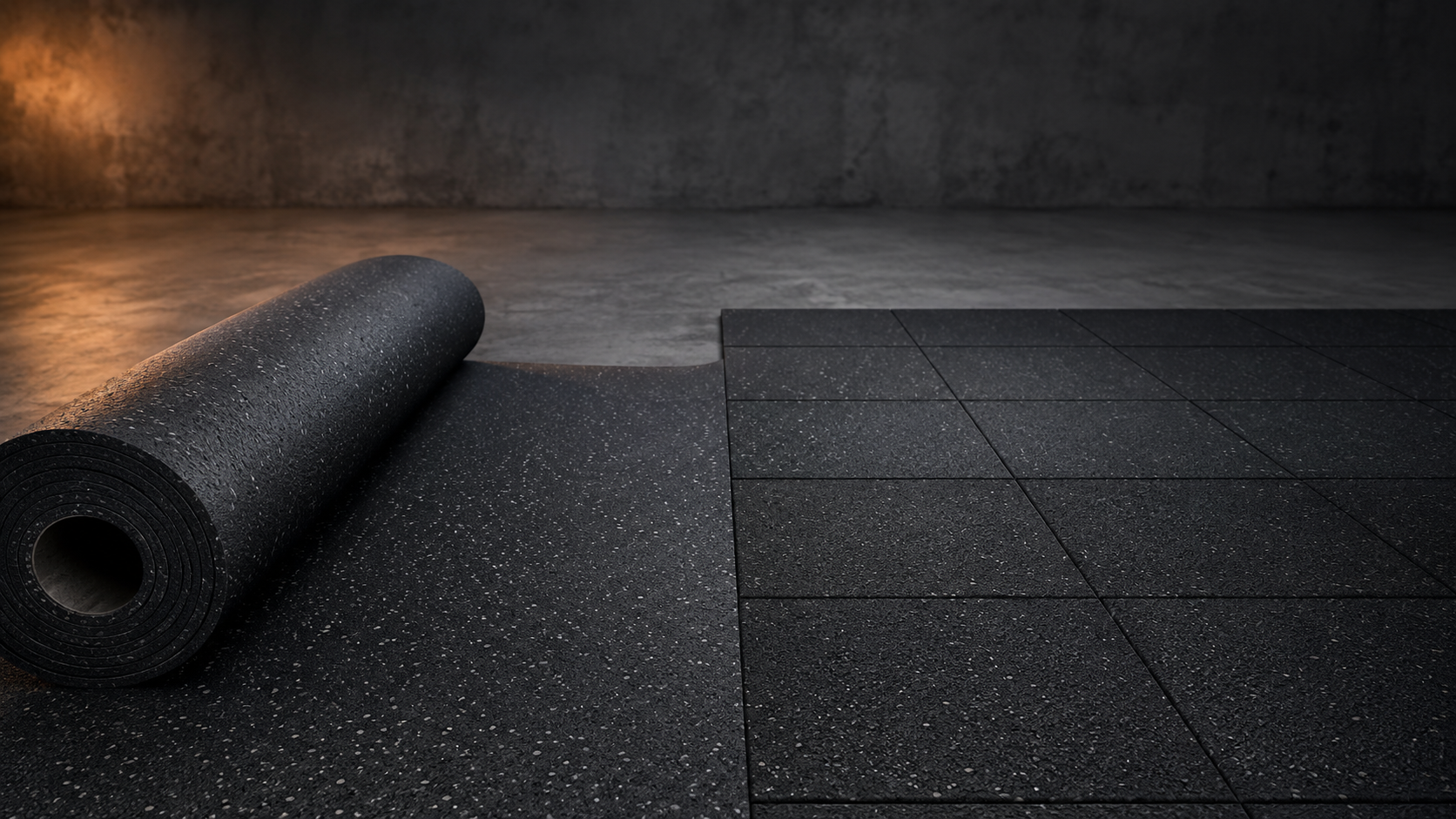
Rubber rolls vs rubber tiles: which should you choose?
Rubber rolls and rubber tiles do the same job: they put a shock-absorbing rubber layer between your weights and the concrete. They can be made from the same rubber, so the format alone tells you nothing about how durable, dense or hard the floor is, or whether it suits dropped weights. That is decided by how the product is built, not by the shape of the piece. So it pays to narrow the comparison to what the format actually changes: the number of seams, the handling and effort at install, whether you can replace a damaged section, and the waste when you cut. Compare thickness, density and load capacity separately, against the real data for each product.
The short answer
| Rolled gym rubber mat | Straight-edge rubber gym tiles | Interlocking rubber gym tiles | |
|---|---|---|---|
| Dimensions | 10 m × 1 m × 5 mm (roll) | 1000 × 1000 × 15 mm | 485 × 485 × 10 mm |
| Material | Rubber | Rubber | Rubber |
| Unit of sale | Roll (10 m) | piece (= 1 m²) | piece |
| Seams | Fewest | Butt joint | Puzzle edge |
| Installation | Heavier, fast over a large area | Needs a flat base and alignment | No adhesive, easy for one person |
| Best for | Large fixed areas | Hard-wearing, replaceable, heavier use | Solo install and re-layable spaces |
| Price | Shown incl. and excl. VAT | Shown incl. and excl. VAT | Shown incl. and excl. VAT |
Feature-by-feature comparison
| Criterion | Rolls | Tiles |
|---|---|---|
| Cost and coverage | Fast coverage of large areas | Buy only the area you need |
| Install effort | Heavier to handle, few seams to align | Lighter pieces, more seams |
| Seams | Fewest seams | More seams (butt or puzzle) |
| Thickness (here) | 5 mm | 10 mm (puzzle) or 15 mm (straight edge) |
| Handling weight | One heavy unit per roll | One light piece at a time |
| Repairability | Patch or re-lay a run | Swap a single piece |
| Portability | Fixed once laid | Can be lifted, especially puzzle edge |
| Surface continuity | Nearly seamless | A seam at every tile edge |
Format doesn't decide material or load capacity
The first and most important difference is what the format does not determine. A roll and a tile can share the same rubber, so a tile isn't automatically tougher than a roll, nor a roll more resilient than a tile. Wear resistance, behaviour under a dropped weight and load-bearing under a narrow machine foot depend on construction, which you compare from the product data — not from whether the piece is big or small.
The same holds for concentrated load. Pressure is force divided by contact area, so a narrow rack foot, a frame post or a caster creates far higher local pressure than the same weight on a wide base. Indentation also depends on how long the load sits there, the hardness of the rubber, the thickness, the temperature and whatever is underneath the floor. "Will it hold a 300 kg machine?" is incomplete without knowing how that weight reaches the floor.
Install effort and seams
A roll goes down fast across an empty room: you unroll one piece, trim the edges, and a large area lands in a few runs with little aligning. The downside is weight, because a full 10 m roll is heavy and awkward, so most people lay it with a second pair of hands. Before you cut and glue, the roll needs to be unrolled and left to relax and lose its curl; cutting or gluing a tensioned, freshly unrolled roll gives peaked or open seams later. An over-compressed seam lifts too, and a too-loose one leaves a gap, so even "few seams" on a roll depends on tidy laying.
Tiles go down piece by piece, each lighter to carry, but you set and join far more edges. Straight-edge tiles butt against each other and need a flat base, a true square and careful alignment to keep the joints tight. Puzzle tiles join with a self-seating puzzle edge, so one person can floor a room without adhesive. It's worth remembering that "tile" doesn't automatically mean adhesive-free: puzzle tiles usually loose-lay, but straight-edge tiles in a permanent, heavy-use installation usually need adhesive. Loose-laid tiles also change dimension with temperature, so respect the perimeter gap the manufacturer specifies; a floor squeezed tight against every wall can buckle when it warms.
Seams, liquids and rolling traffic
A roll gives the most complete surface, with the fewest seams, so there are fewer edges to open up, lift, collect dirt or catch a small wheel over time. But fewer seams don't make a roll waterproof: without explicitly sealed seams and finished edges, liquid still reaches the substrate through seams, edges and damage. Tiles have more seams, so more possible paths for water, sweat and fine debris to get below the surface; a tight puzzle edge reduces visible gaps but doesn't seal liquid on its own. Treat neither format as a waterproof floor without an explicit sealing spec.
For equipment that rolls and turns, seams are the weak point when they are open, proud, curled or poorly joined. Hard casters create higher local pressure than wide feet, so both joint quality and subfloor flatness matter in either format. With equal construction and thickness, a roll usually presents fewer edges under wheels than tiles, but a thick, well-engineered tile can outperform a thinner roll under heavy or concentrated loads. Fewer seams is a real advantage for rolls, but don't confuse it with proof of higher load capacity.
Dropping weights: construction, not format
Dropped-weight performance is decided by the whole floor build: the rubber formulation, density, thickness, internal structure, the subfloor and any underlay or platform — not whether the surface is a roll or a tile. So neither "roll" nor "tile" is a shortcut for heavy-lifting suitability. Of the three options here, the 15 mm straight-edge tile is the thickest and best handles controlled free-weight work in a fixed spot, but for regular heavy-bar drops none of these formats is a dedicated 20–40 mm lifting platform. Solve that zone separately, with a thicker impact-focused tile or a platform, and confirm drop suitability with the supplier rather than assuming it from thickness.
Repairability and single-section replacement
Damage is where the formats separate most clearly. A roll is one surface, so a deep gouge or burn usually means cutting out the spot and fitting a patch, or re-laying the whole run; the repair creates new perimeter seams and may show a colour or texture difference. Tiles isolate the problem: a worn or torn piece lifts out and a fresh one drops into the same footprint without disturbing the rest. Straight-edge tiles let you replace one 1 m² piece, and puzzle tiles unclip even faster.
Because of that, it's worth keeping a few spare pieces from the same production batch. Recycled-rubber floors can vary in shade, granule distribution and texture between batches, so a successful repair can stay visible if the replacement comes from a different batch. The same applies to a roll patch.
Cost, subfloor and coverage planning
Compare cost as the total installed price per m², not the price on the label. That takes in material with waste, delivery, adhesive or tape where it's needed, subfloor preparation, labour, edge trims and spare stock. A roll covers a large space fast and often works out well for full, fixed floors, while tiles let you buy only the area you need and repair more cheaply over the life of the floor; molded or puzzle tiles can carry a higher make cost per m², but they cut labour where an approved loose-lay is allowed. Because the per-piece price doesn't show the true cost of the floor, compare only after you've reduced both formats to usable m².
The subfloor decides as much as the format. Both need a clean, sufficiently dry, smooth and sound base free of contaminants that interfere with bonding; thinner products reveal unevenness more readily than thick ones. Choosing tiles doesn't remove the need to fix a bad slab, just as a roll doesn't make up for cracks, high spots or moisture. When gluing, respect the adhesive's cure time before traffic, equipment and rolling loads; a floor can be permanently damaged during installation even when the product itself is good.
When planning coverage, first measure length and width in metres for the m², sketch the cut-outs around posts, doors and machines, and add a surplus for cutting and offcuts. For rolls, divide the area by the roll's coverage, and plan the run direction so the seams fall away from the busiest zones. For straight-edge tiles, each piece is 1 m², so the m² maps directly to the piece count. For puzzle tiles, count pieces by the 485 × 485 mm size and allow for puzzle edges that overlap slightly. In a small or irregular room, tiles often leave less unusable waste than a roll; in a large, rectangular one, a roll gives fewer seams.
Not sure about thickness before you buy? Read how to choose gym flooring first, then come back to plan your coverage.
Rolled gym rubber mat: a closer look
The rolled gym rubber mat lays a continuous 5 mm surface across a whole room in one run, in a 10 m × 1 m roll format, sold by the roll. It's for anyone covering a large, fixed area who wants as few edges underfoot as possible.
What it does well:
- Continuous surface with the fewest seams
- Covers large, rectangular areas quickly
Where it falls short:
- Heavy and awkward to handle; usually laid by two people
- Harder to replace a damaged section than a tile
- 5 mm is for cardio and lighter work, not for bar drops
Best for: large, fixed gym areas where a continuous floor matters.
Straight-edge rubber gym tiles: a closer look
Straight-edge rubber gym tiles give a 15 mm surface in 1 m² butt-jointed pieces (1000 × 1000 mm). Of the three options here they give the thickest rubber and best handle controlled free-weight work in a fixed spot, with simple single-piece replacement.
What it does well:
- Thickest surface here, 15 mm
- Replace an individual tile when a piece wears out
Where it falls short:
- More seams than a roll
- Needs a flat base and alignment, and often adhesive in a permanent installation
Best for: harder-wearing floors and free-weight zones where easy piece replacement matters.
Interlocking rubber gym tiles: a closer look
Interlocking rubber gym tiles join with a puzzle edge and no adhesive, in 485 × 485 × 10 mm pieces. They are the easiest to lay on your own and the simplest to lift and rearrange later.
What it does well:
- No adhesive, easy one-person installation
- Lift out and rearrange; partial coverage is simple
Where it falls short:
- Thinner 10 mm profile; not a bar-drop zone
- Visible puzzle seams can be stressed under turning on an uneven base
Best for: solo installations and spaces that may be rearranged.
The final verdict
Choose a roll if you're covering a large, fixed space and want the fewest seams underfoot, with a second person to handle the weight.
Choose straight-edge tiles if the floor takes heavy use and you want the thickest surface here, which you can repair piece by piece.
Choose puzzle tiles if you want the easiest solo lay and the option to rearrange the space later.
And if you mix uses, you can combine formats: a roll under a fixed rig and tiles in an adaptable corner is a common, practical layout. For regular heavy weight drops, add a separate thicker zone, because none of these three formats is a dedicated lifting platform.
Still weighing rubber against a softer surface? EVA puzzle tatami mats are the better option for martial arts and bodyweight work in the same range. Compare everything in the gym and sport flooring range, or read how to choose gym flooring first for guidance on thickness.
Shop the compared products

Rolled gym rubber mat 10m*1m, 5 mm thick
a continuous floor for a whole room
€275.00 incl. VAT
€220.00 excl. VAT

Straight-edge rubber gym tiles 1m*1m, 15 mm thick
15 mm, replaceable piece by piece
€33.00 incl. VAT
€26.40 excl. VAT

Interlocking rubber gym tiles, 485*485 mm, 10 mm thick
easy one-person installation
€7.75 incl. VAT
€6.20 excl. VAT
Frequently asked questions
Are rolls or tiles cheaper for a gym floor?
It depends on the total installed cost per m², not the price per piece. Rolls often cost less per m² for a whole room and cover the area fast; tiles let you buy only the area you need and swap a single piece more cheaply, which can cost less over the life of the floor. Compare only after you've reduced both formats to usable m², including waste, adhesive, delivery and labour.
Which has fewer seams, and does that mean it's waterproof?
Rolls have the fewest seams; a 10 m roll lays a nearly seamless surface, while both tile types add a joint at every edge. But fewer seams don't mean waterproof: without explicitly sealed seams, liquid still reaches the substrate through the seams and edges even on a roll.
Is a tile more durable because it's thicker?
Not necessarily. Thickness gives more material to deform, but durability and indentation resistance depend on density, hardness and construction. A thicker, softer tile can press down more than a thinner, denser one. Compare the product data, not just the millimetres.
Which format is better for dropping dumbbells and bars if they're the same thickness?
Neither format on its own. Drops are decided by the whole floor build and the subfloor, not the shape of the piece. Of these options the 15 mm tile best handles controlled work, but for regular heavy drops you need a separate 20–40 mm lifting platform; confirm suitability with the supplier.
Which is easier to install on my own?
Puzzle tiles. They join without adhesive, so one person can floor a room with no gluing and no precise alignment. Still, "tile" doesn't always mean adhesive-free: straight-edge tiles in a permanent installation often need adhesive.
Which format is easier to repair?
Tiles. A worn straight-edge or puzzle piece lifts out and a fresh one drops into the same spot, so you never re-lay a whole run. Keep a few spares from the same batch, because recycled rubber can vary in shade between batches.
Can I move the floor to a new space later?
Tiles travel better, especially the puzzle type, which unclips without tools. A glued roll is meant to stay put as a fixed floor.
What about small or irregular rooms?
Tiles fit small and awkward rooms better: you cut and lay pieces around posts and doors so they stop exactly at the area you need, usually with less unusable waste than a roll.
Shop gym flooring
Decided on a format? Browse the gym and sport flooring range and order rolls or tiles, with prices shown both including and excluding VAT, in stock for fast delivery.