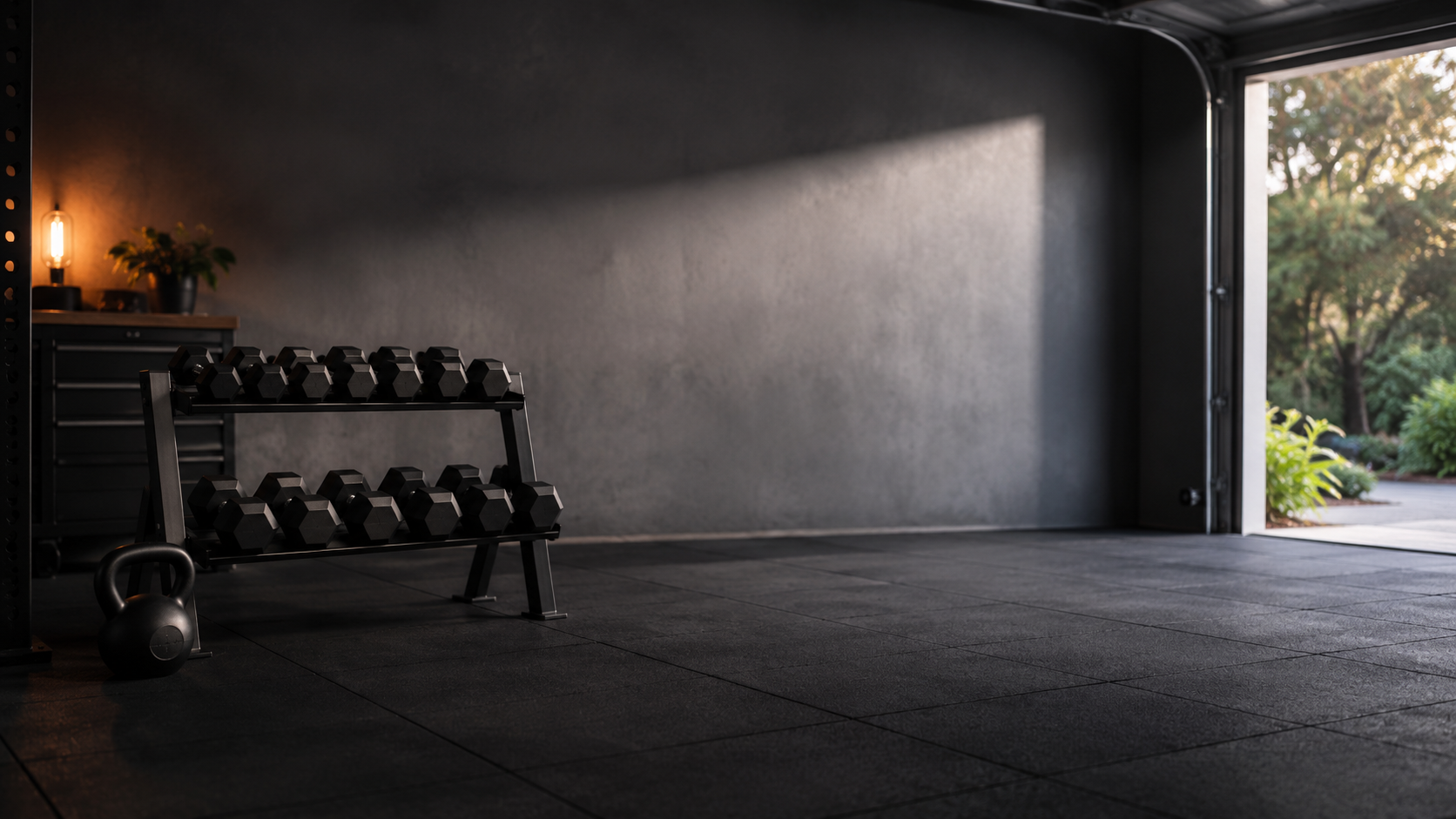
Best Flooring for a Home or Garage Gym
Home > Guides > Best Flooring for a Home or Garage Gym For most home and garage gyms the simplest answer is [interlocking rubber gym tiles](/en/products/interlocking-rubber-gym-tiles/) — you lay them yourself, no help needed. If you want one seamless surface across the whole garage, take a [rolled gym rubber mat](/en/products/rolled-gym-rubber-mat/); if you need a tougher floor you can later repair tile by tile, choose [straight-edge rubber gym tiles](/en/products/straight-edge-rubber-gym-tiles/).
What actually decides your home gym floor
A gym floor is the elastic layer between your weights and the concrete. Its job is to spread and slow the impact, dampen the noise reaching neighbouring rooms, and protect the slab beneath. How well it manages that depends not on what the material is called but on its thickness, its density, and how it is laid.
Before you compare products, answer two questions: what is your space like, and how do you train in it. Those two answers give you the thickness, the format, and the coverage plan. The rest of this section works through each of those decisions.
Look at the load, not the total weight
The most common mistake is choosing a floor by the total weight of the equipment. What matters is local contact pressure — force divided by contact area. A narrow rack foot, a plate edge, or a machine caster creates far higher pressure at one point than the same weight spread across a wide base. So look first at where the contact area is smallest and where the impact is hardest, not at what it all weighs together.
Dropping a bar is a special case. It is not a static load but a dynamic impact, whose peak force depends on the mass, the drop height, the plate type, and how abruptly it stops. There is no simple factor that turns a bar's mass into a required floor rating. A floor that easily holds a 200 kg rack standing still is not automatically good for a 100 kg bar dropped onto concrete.
Rubber bumper plates and a thicker elastic layer help here because they spread the blow over a larger area and stretch it out in time, unlike a hard metal edge that packs all the energy into one point. All of that energy has to be absorbed in the end by a stack of layers: the plates on the bar, the floor, the platform, and finally the concrete slab.
Thickness by real use
There is no single "right" thickness for a garage gym, because the protection you need depends on the heaviest use, the frequency and height of drops, the plate type, and the state of the concrete. There is only a rough orientation by how you train — and these are use-case ranges, not load ratings:
- Around 6–10 mm for cardio, bodyweight work, and fixed machines with no dropped weights.
- Around 10–20 mm for regular, controlled work with free weights, without deliberate dropping.
- Around 20–40 mm, usually as a thick impact tile or a built-up platform, where heavy bars are dropped regularly.
Thicker is not automatically better. Thicker rubber costs more, raises the threshold under the door, and can foul the door on opening and at transitions. If it is also soft or porous, a narrow machine foot rocks on it more than on a thinner but denser base. The aim is to balance impact protection against equipment stability and floor height, not simply to pile on millimetres.
Density and hardness, not just "rubber"
"Rubber" is not a single grade of quality. The same thickness behaves quite differently in two constructions, depending on the compound, the density, the hardness, and whether it is solid vulcanized rubber or granulate bound with a separate binder. A denser, firmer tile resists indentation under a rack foot and springs back after an impact, while a soft, low-density base compresses and takes a permanent set more easily.
A permanent mark under a machine foot does not depend on hardness alone. Rubber is viscoelastic, so how long the load stands, over how small a contact area, at what temperature, and what sits beneath the floor all matter. A thin, hard foot standing in the same spot for days will leave a mark even on a floor that feels firm enough to the touch. If a machine has narrow feet, spread the load with larger feet or a rigid pad where the equipment allows it.
Resistance to abrasion and tearing comes into play where equipment is dragged. Benches, sleds, and metal feet pulled across the floor wear the surface faster than a static load does. That is a separate question from impact protection, so for a zone where equipment is dragged, choose the floor by surface resistance too, not by thickness alone.
Subfloor, flatness and moisture
The slab under the rubber matters as much as the rubber itself. It must be sound, clean, and smooth enough for the chosen format, free of dust, grease, and coating residues that stop the adhesive bonding. A weak, dusty surface must be mechanically cleaned and stabilised.
"Flat" and "level" are not the same thing. Flatness is deviation from a plane; level is slope relative to the horizontal. A garage slab may be deliberately laid with a gentle fall towards a drain or the door and still be flat enough for a floor. Do not try to remove that fall; correct only the local highs and lows, because they telegraph through thin surfaces and rock the equipment.
Moisture is a risk even when the rubber itself takes water. Excess moisture in the concrete breaks down the adhesive and creates bubbles and debonding, while damp trapped beneath a sealed floor together with dust, cardboard, or wood feeds mould and leaves a smell. A "waterproof" tile does not make a damp slab fit for gluing. The adhesive manufacturer sets the limit for how damp the concrete may be, so check it before you commit to a glued-down surface.
Quick check for a damp slab
Before laying, tape a square of plastic sheet to the bare concrete overnight. Condensation under the sheet the next morning is a sign the slab is drawing moisture from the ground. For a slab prone to damp, a loose-lay format that lets the floor breathe is a safer choice than a glued-down, continuous sheet. Upstairs and timber floors rarely raise moisture, but they flex, so spread the load and avoid a heavy rack standing with its full weight on a single joist.
Noise: what rubber really can and cannot do
Rubber softens the sharpness and peak force of an impact because it deforms and burns off some of the energy in doing so. But that does not mean the room is soundproofed. The low-frequency energy of a dropped bar still passes into the concrete slab, the walls, and the structure, and is heard in the next room or on the floor below.
It is worth telling two things apart. Airborne noise is the clatter and hum that travels through the air. Impact noise is the thud that enters the structure through mechanical contact and turns back into sound somewhere else. Soft wall panels can cut the echo in the room, but they do not solve the dull thud carried through the floor.
For impact noise, a thicker and more compliant layer helps, ideally in several layers that lengthen the time over which the blow is slowed. Density alone is not a reliable indicator: a thin, very dense tile can transmit more low-frequency impact than a thicker, more compliant layer. For a room above a bedroom or next to a neighbour, choose the thickest option your budget and space allow, and drop the heaviest weights on a separate platform.
Zoning: where to invest in thickness
Most gyms do two jobs in the same room. The lifting zone takes bars, dumbbells, and kettlebells dropped from height. The rest carries the static weight of machines and footfall, with no sudden impact. There is no sense in covering the whole room in the thickest rubber.
So plan thickness by zone. Keep the thick, hard-wearing surface for where the weights land, and lay thinner, firmer, smoother rubber elsewhere. It is common to cover the whole room in one thinner format and stack extra rubber or a platform only under the bar path. That way you protect the concrete without paying for thick rubber across the whole floor.
House and garage are not the same starting point
A heated room indoors gives you a warm, dry, level base, but it also imposes stricter rules on noise. There, comfort underfoot and consideration for the household count for more than drainage or cold.
A garage has a harder slab but more unknowns: cold concrete, the odd damp patch, and a fall towards a drain by the door. A loose-lay tile floor copes with those better than a glued-down, continuous sheet. If a car also lives in the same garage, that is a completely different regime — more on that below.
Format and installation effort
A roll covers a large rectangle with the fewest seams and gives a continuous look, but it is heavy and awkward to cut and move, so a solo install gets harder the wider, longer, and thicker the roll. Straight-edge tiles are modular and replaceable one at a time, but their butt joints demand a flat substrate, a square layout, and tidy alignment; a difference in dimension or any movement leaves visible gaps or a difference in height.
Interlocking tiles are chosen for a glue-free install and for a floor that lifts easily later. The profiled edge is still no guarantee against movement: pivoting, casters, and heavy rolling can stress a joint, lift it, or pull it apart if the tile is too thin or too soft or the substrate is uneven. It is worth remembering that a puzzle edge is no indicator of thickness; there are thin puzzle tiles and thick impact tiles with the same edge. The puzzle edge is a joining method, not proof of impact protection.
Seams are the weak point under rolling and turning, because a wheel can catch on a difference in height or shear sideways across the joint. Fewer seams, a tight fit, a flat substrate, and adequate restraint all lower the risk. That is why a floor that takes a static load well tends to give way first at the seam when a bench or machine is moved again and again.
Before the rubber arrives
Empty the room, sweep the slab, and let the material acclimatise to the space before you cut and glue. Rolls and tiles contract in the cold and change dimension, so cutting and joining cold, tightly rolled material leaves gaps and peaked seams later. The manufacturer sets the exact acclimatisation time and the minimum installation temperature; cold rubber is stiff, and the adhesive needs its own temperature too, so a winter install on a cold slab is the most sensitive of all.
A car in the same garage: a different regime
If a car also stands in the garage, the floor goes through a quite different cycle: long-duration wheel loads, scrubbing as the wheel turns on the spot, hot tyres, tracked-in water and salt, and leaking oil or fuel. A floor being good for a gym does not mean it is good for a vehicle.
Ordinary SBR and EPDM rubbers are not intended for prolonged contact with mineral oil and fuel; depending on the compound, that can cause swelling, softening, or staining. There are specially formulated oil-resistant rubbers for that use. Dilute road salt is usually gentler on rubber than petroleum fluids, but contaminated water can pass through the seams and act on the adhesive or the concrete. Marks and stains from hot tyres depend on the compound and the finish, so treat them as a question of compatibility, not a property of every rubber.
The practical solution is to separate the car area from the training floor, or to lay rubber made specifically for vehicles in the driving lane. Check with the supplier whether a given floor is approved for vehicle tyres, for the loads of turning wheels, and for the fluids you expect; that is not something to assume.
Odour, cleaning and maintenance
New rubber can have a smell that depends on the compound, the share of recycled material, the binder, and the ventilation. The strength of the smell is no measure of health risk, and there is no universal number of days after which it disappears. Ventilate the room well in the first days, and in a closed or poorly ventilated garage expect an initial smell and ask for documented emissions data rather than a "no smell" label.
Maintenance is simple. Sweep or vacuum up sand and chalk so they do not grind into the surface, then go over it with a damp cloth and a mild, pH-neutral cleaner. Avoid harsh solvents and strong degreasers, which over time can dry out or stain the rubber. With tiles you can lift a soiled or damp piece, clean both sides, and put it back, which stops trapped moisture turning into a lasting smell.
Budget by zone, not by room
Rolls cover large areas quickly and often work out cheaper per m² for a whole room. Tiles are a little more demanding to handle, but you buy exactly the area you need and swap one damaged tile instead of a whole cut length. For a rectangular room, allow roughly 5–10% extra material for cutting around corners and doors and for future replacements; irregular shapes and columns can call for more.
Compare the total installed cost per m², not the sticker price. That includes the actual material with waste, the adhesive or tape, the primer, any moisture protection, the edge ramps, and the labour. A lower unit price can turn into a more expensive floor once it all adds up. Think long term too: a floor you can lift and re-lay moves house with you, and replacing one tile is more economical than re-laying the whole room after one heavy drop chips the surface.
Home gym floors compared
| Option | Thickness | Installation | Best for |
|---|---|---|---|
| Rolled gym rubber mat | 5 mm (10 × 1 m roll) | Continuous surface, hard to lay solo | A permanent floor across a whole garage |
| Straight-edge rubber gym tiles | 15 mm (1000 × 1000 mm) | Butt joint, needs a flat substrate and alignment | A hard-wearing, replaceable surface for heavier use |
| Interlocking rubber gym tiles | 10 mm (485 × 485 mm) | Puzzle edge, no adhesive, easy DIY | Most home and garage gyms |
| Your situation | Recommendation | Why |
|---|---|---|
| First home gym, mixed use | Interlocking tiles | Easy to lay, extend the area over time |
| Permanent garage gym, whole floor | Roll | Continuous surface, fewest seams |
| Heavy lifting with frequent drops | Straight-edge tiles + a platform zone | Thicker, denser surface where you drop the bar |
| Renting or a possible move | Interlocking tiles | Lift them and re-lay elsewhere |
| Slab prone to damp | Loose-lay format | Lets the floor breathe, no trapped moisture |
| A car in the same garage | Separate lane or vehicle-rated rubber | Gym rubber is not approved for oil and hot tyres |
| Martial arts, floor work | EVA tatami | Softer foam surface for landing |
Home gym flooring recommendations

Interlocking rubber gym tiles, 485*485 mm, 10 mm thick
They are the best fit for a mixed home gym with weights, a…
€7.75 incl. VAT
€6.20 excl. VAT

Rolled gym rubber mat 10m*1m, 5 mm thick
It is the best fit for a permanent garage gym with a known…
€275.00 incl. VAT
€220.00 excl. VAT

Straight-edge rubber gym tiles 1m*1m, 15 mm thick
They are the best fit for lifting-led training where heavy…
€33.00 incl. VAT
€26.40 excl. VAT

EVA puzzle tatami mats
They cushion body falls, but they do not damp dropped…
€14.90 incl. VAT
€11.92 excl. VAT
More gym flooring help
For a complete walkthrough of thicknesses and formats, read how to choose gym flooring. You will find every option in one place in the gym and sport flooring range. Still weighing tiles against a roll? The product pages above carry dimensions, colours, and prices both including and excluding VAT, so you can plan coverage and cost against your own measurements.
Frequently asked questions about home gym flooring
What thickness do I need for a home gym?
It depends on the heaviest load, not the size of the room. For cardio and bodyweight work, around 6–10 mm is enough. For regular, controlled work with free weights, reckon on 10–20 mm. For regularly dropping heavy bars you need a thicker impact tile or a platform, around 20–40 mm, and only in the zone where you drop the bar.
Roll or tiles for a garage gym?
Tiles are better when you want an easy solo install and the option to replace a single tile. A roll is better when you want a continuous, permanent floor across the whole garage with the fewest seams. If equipment rolls or pivots often, fewer seams and a flat substrate matter more than the format.
Will rubber protect my garage slab?
A rubber floor spreads and slows the impact of dropped weights and distributes machine loads over a larger area, which protects the concrete from chipping. But that protection depends on the thickness in the drop zone: a thin floor under a heavy bar does not protect the slab. Choose thickness for the hardest impact, not the average.
Will thicker rubber quiet the drops enough for upstairs or the neighbours?
Rubber softens the dull thud but does not remove it on its own. The low-frequency energy still passes into the slab and the structure. For a room next to a neighbour, take the thickest option the space allows, drop the heaviest weights on a separate platform, and do not expect silence from rubber alone.
Do I have to glue the rubber to the concrete slab?
Not always. Puzzle tiles and loose-lay formats hold without glue and lift easily. Rolls and straight-edge tiles in larger rooms and under rolling often need fixing down. If the slab is damp or you have no data on waterproofing beneath it, do not glue directly; test the moisture and reach for a loose-lay format.
How do I check whether the slab is too damp to glue?
Tape a square of plastic sheet to the bare concrete overnight. Condensation underneath it in the morning is a sign the slab is drawing moisture. The adhesive manufacturer sets the limit for how damp the concrete may be for gluing, so look for that figure for a permanently glued surface; otherwise choose a loose-lay format.
Does a sloped garage slab need levelling first?
Not necessarily. The fall towards a drain or the door is deliberate, so leave it alone. Correct only the local highs and lows, because they telegraph through thin rubber and rock the equipment. "Flat" is not the same as "level".
Which format is easiest to install yourself?
Puzzle tiles. They join without glue, one person can floor a room in an afternoon, and a wrongly cut tile costs one piece, not a whole row. A roll is the fastest over a large area, but heavy for one person and unforgiving of poor measuring.
Can a car and a gym share the same floor?
Only with care. Gym rubber is not intended for oil, fuel, and hot tyres, so it can swell or stain. Separate the car lane from the training floor, or lay rubber explicitly approved for vehicles there, and check with the supplier which fluids and loads it will take.
How do I clean and maintain a rubber floor?
Sweep or vacuum up the sand, then go over it with a damp cloth and a mild, pH-neutral cleaner. Avoid harsh solvents and degreasers. With tiles, lift a soiled piece, clean both sides, and put it back — that way you head off trapped moisture and smell.
Rubber or EVA tatami for me?
Rubber suits weights and machines because it damps dropped loads and takes rack feet. EVA tatami suits martial arts and floor work, where a softer foam cushions body falls. Choose by activity, not by what is thicker or cheaper.
Ready to floor your training space?
Ready to kit out your training space? Compare the three recommendations in the gym and sport flooring range and order the option that fits your garage, with prices shown both including and excluding VAT.