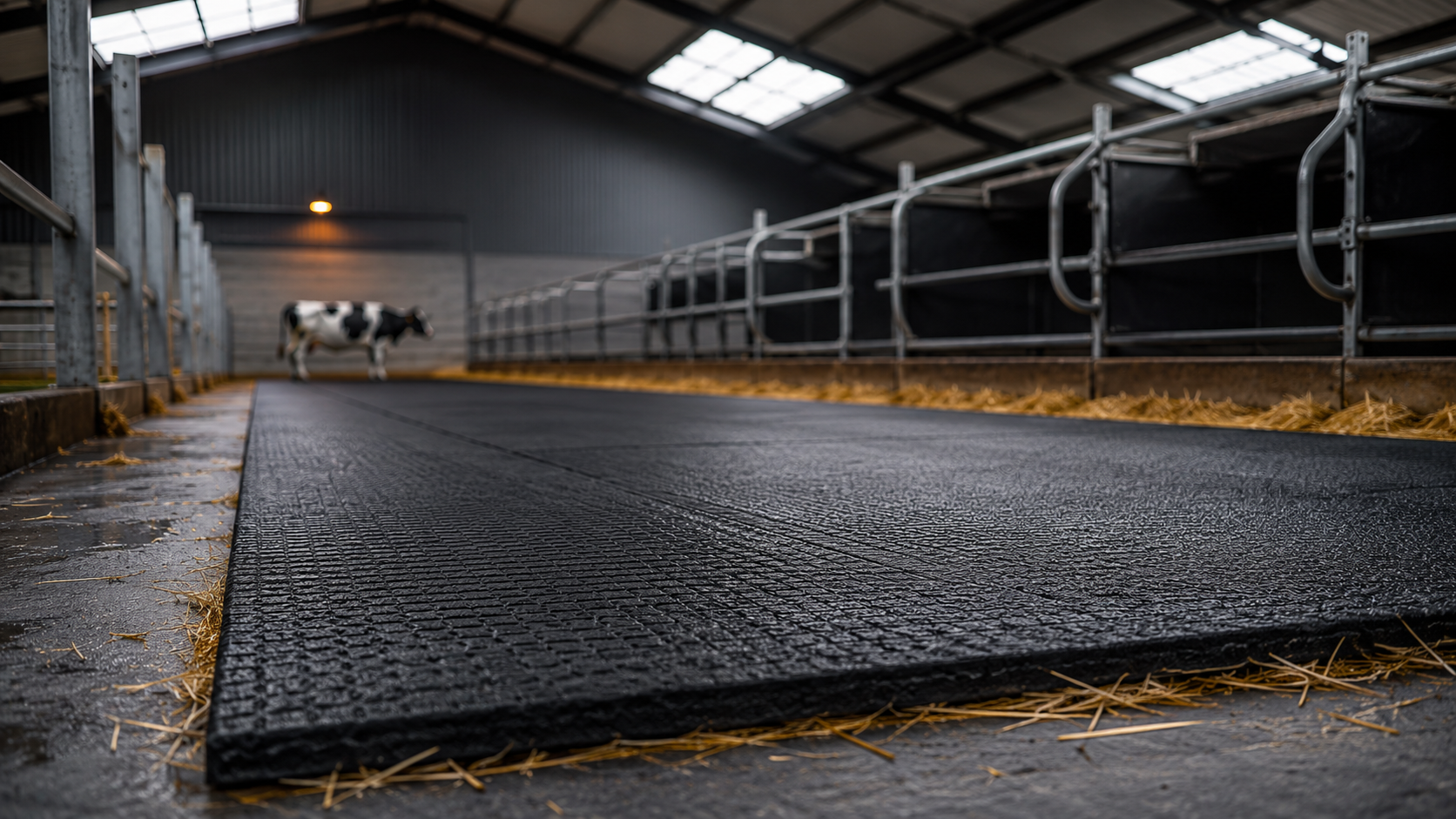
Choosing a rubber floor for stables and cattle
A bare concrete slab is hard underfoot for an animal that lies down and gets up many times a day, and a cold, slippery floor makes the building harder to keep clean. Rubber flooring makes that slab more compliant and safer under the hoof, but it is not a cure: you choose it for footing, comfort and washability, not as a measure against disease or lameness. This guide explains what actually makes a floor good: controlled compliance rather than raw millimetres, grip in wet and soiled conditions, bedding that rubber reduces but does not remove, hygiene that depends on joints and drainage, and the fixing, subfloor and sizing that hold it all together. By the end you will know exactly what to confirm with the supplier before you order.
What a rubber stable floor actually does
A rubber stable floor is a thick rubber sheet laid over concrete or compacted hardcore to soften a hard floor, improve footing under hooves and give a washable surface in stalls, cubicles and walking alleys. The best-supported effects are on gait, slip risk, claw loading and comfort; that evidence does not support a blanket claim that rubber prevents lameness or joint disease. EFSA's 2023 dairy-cow welfare opinion notes that soft flooring such as rubber on walking alleys may reduce the claw wear linked to some claw disorders, and controlled studies report better locomotion on yielding rubber than on concrete. That is a good reason to choose rubber, but treat it as a floor improvement, not a medical intervention.
It is worth clearing up one common mix-up straight away. Rubber is not the same as a sufficiently cushioned bed. Thin or hard rubber sheets with little bedding can improve on bare concrete and still be too firm for prolonged lying, especially for mature or lame cows; field studies in some housing systems link thin mats and mattresses with more hock lesions than deep, well-managed loose bedding. So judge the lying surface as a whole: the floor, the depth of bedding, the geometry of the cubicle, cleanliness and maintenance, rather than sheet thickness on its own.
The sections below work through those decisions in turn, then show how to work out how many mats a stall needs.
Thickness and controlled compliance, not just millimetres
Thickness in millimetres tells you how far the floor can yield before the hoof feels the hard base beneath. A thin sheet protects the surface, but the hardness of the concrete passes straight through it. Thicker is not automatically softer or safer, though: too much give reduces stability when an animal pivots, rises or bears its weight on a single hoof, while an overly hard sheet offers too little cushioning. That is why cattle-floor testing (DIN 3763, DLG) measures deformation and elasticity under load alongside other properties, rather than treating thickness as the only comfort metric. The target is controlled compliance under load.
There is no single correct thickness for every building, cubicle, alley or species. For solid rubber sheets, Penn State Extension describes roughly 13–19 mm as the most common range for horse-stall mats, while DLG-tested cattle products often run around 18–24 mm; as a practical range for durable use over concrete, take about 13–25 mm and compare measured deformation, hardness and intended use rather than the number alone.
Flexadur's cow mat is 17 mm of solid rubber. That sits within the normal commercial range for heavy-duty animal mats. Confirm the exact thickness, manufacturing tolerance and intended species on the current technical datasheet before ordering.
Grip in wet and soiled conditions
Grip comes from the surface texture that holds a hoof so it does not slide. It matters most in the moments when an animal is most vulnerable, as it lies down and heaves back up, because a slip risks injury and an animal that does not trust the floor will not settle. So in areas with frequent hoof traffic, choose a pronounced, textured, non-slip top surface; Penn State Extension specifically warns that untextured solid horse-stall mats can be slippery when wet.
But dry, wet and manure-contaminated grip are three separate conditions. Dairy-floor research has measured lower friction after wetting or contamination, and a worn, polished surface performs worse than a new one. A floor that grips well when clean and dry can behave completely differently once water, urine or slurry is present. Ask for slip evidence in the wet and soiled state, tied to the relevant species and method (frameworks such as ISO 22941 and DIN 3763 for cattle, DLG hoof simulators for horses), rather than accepting a bare "anti-slip" label. And plan cleaning, drainage and wear inspection as part of slip control, because texture alone does not guarantee safe footing on a manure-fouled floor.
Bedding that rubber reduces but does not remove
Rubber usually reduces the amount of bedding a comfortable lying surface needs, but it rarely removes it. English statutory guidance for licensed horse-hiring establishments requires adequate bedding and states that where rubber matting is used in stables there must still be some bedding to absorb urine; Scottish equine welfare guidance says the same. Dairy guidance likewise recommends bedding over mat and mattress systems to keep the surface clean and dry and to reduce hock injury.
The reason is that bedding does what rubber cannot fully replace: it absorbs urine, keeps the lying surface dry, reduces focal pressure and abrasion, and provides a replaceable contaminated layer that you simply muck out. So treat bedding savings as an easier daily routine, not as proof that bedding can be removed entirely. A zero-bedding surface over rubber readily produces wetness, odour and pressure points, even when the rubber itself is good.
Hygiene depends on joints and drainage, not just a washable surface
A washable top surface is not the same as a hygienic floor. Solid rubber sheets are largely impervious to urine and wash water at the mat body, but joints, perimeter gaps, anchor penetrations and underside channels still let liquid through. Water that passes a joint reaches the underside and is trapped over the impervious concrete, producing odour, contamination and hard-to-clean deposits that stay hidden until the mat is lifted.
So plan hygiene as a whole system. Keep joints tight, or choose an interlocking product, but understand that a joint does not by itself make the floor liquid-tight unless the product is specifically designed and tested as a sealed system. Handle drainage independently of the rubber: impervious floors rely on bedding and floor fall to move urine and wash water, with a typical fall of around 1.5–2% where slope is used, while some regulated equine guidance specifies a minimum gradient of 1:80. There is no single universal slope for every building. Rubber laid over a floor that ponds water will stay wet at the seams and edges regardless of its texture.
Chemical resistance depends just as much on the compound. Resistance to urine, ammonia, organic acids, detergents and disinfectants should be demonstrated for the actual rubber, not inferred from the word "rubber"; cattle-floor testing can cover resistance to uric acid, ammonia, acid mixtures, peracetic acid and barn disinfectants. In an aggressive-cleaning or high-manure environment, an incompatible compound can swell, harden, crack or lose its surface properties, so ask for an approved-product list and compound-specific data before you buy.
Subfloor, fixing and equipment
Before solid sheets go down, the subfloor must be firm, level and stable, for example sound concrete or well-compacted hardcore; an uneven base allows rocking, open joints and concentrated wear. Even the best sheet over a poor base will shift, curl and trap waste, however durable the rubber is.
Multiple mats need to be tied together, by tight butt joints and/or mechanical restraint depending on the product. Unsecured mats "walk", separate and can be lifted by the animal; movement enlarges joints, creates trip edges and pumps contaminated liquid underneath. A free edge is usually the first thing a hoof, scraper or fork catches, so perimeter restraint, wall-to-wall fitting, edge strips or anchors matter, and the fixing method must suit the base, the cleaning system and whether the floor has to be removable.
Durability is better described by abrasion and tear resistance, permanent deformation and dimensional stability than by thickness. Hooves repeatedly load small contact areas, so a sheet that permanently stretches or wears smooth becomes both a maintenance problem and a grip problem. Match the floor to the equipment as well: horses in studded shoes and sharp tools can cut solid rubber, and alleys crossed by automatic scrapers, loaders or other machinery need explicit compatibility confirmation, because comfort under the hoof does not prove resistance to every scraper blade or turning tyre.
Animal type and standards
A floor validated for dairy cattle should not automatically be treated as suitable for horses, calves, pigs, goats or other animals. Hoof geometry, body mass, lying behaviour, bedding needs, chewing risk and cleaning systems all differ by species and age, so on a multi-species farm match each product's documented intended use to each area rather than using one "livestock mat" everywhere.
Read the standards for what they actually test. ISO 22941 specifies characteristics of solid rubber sheets for dairy cattle but explicitly leaves product design out of scope, and it does not certify the whole building, a welfare outcome or suitability for horses. DIN 3763 covers requirements and testing for elastic floorings in cattle walking and resting areas, but it is not a general equine standard, nor Croatian law unless a Croatian document specifically adopts it. DIN 3762 measures the migration of polycyclic aromatic hydrocarbons from rubber stable flooring, a narrow chemical question, not proof that a floor is antimicrobial, easy to disinfect or non-slip. If a supplier cites ISO 22941, DIN 3763, DIN 3762 or a DLG mark, ask for the exact certificate or report and the product variant, and do not assume it covers horses, installation, hygiene or health outcomes.
How many mats your stall needs
Start from the real internal floor dimensions after you subtract walls, posts, drains, feed barriers, curbs and any required perimeter clearance. Do not assume the stated mat dimensions fit an older or irregular stall, because small measurement errors multiply across a row and leave either a loose edge or a mat forced into a buckle.
Each Flexadur cow mat currently ships in a single size, stated as 1830 × 1220 mm. Before ordering, confirm whether those figures are nominal or finished dimensions and whether any interlocking tabs are included in the measurement, because effective installed coverage can differ from the stated size. For a first rough estimate, divide the floor area by the usable coverage of one mat and round up. A layout drawing is more reliable, though, because offcuts are not always reusable and stall dimensions rarely divide evenly by mat size. Allow material for cuts and unusable offcuts, measure first, then order it all at once.
Related resources
Ready to put this into practice? The Cow stable mats page covers the 17 mm rubber mat in full; there you can also confirm the dimensions and the compound-dependent properties, such as resistance to urine and disinfectants. To see the wider range for stables and areas where animals are kept, browse Stable and animal flooring. For help choosing floors elsewhere on your holding, All flooring buying guides gather every Flexadur guide in one place.
Ready to equip your stable?
Once you have measured the stall and settled thickness, grip, bedding and hygiene, the buying part is short. Compare the Cow stable mats against your stall area and order the mats that fit, with the dimensions and properties confirmed for your species.