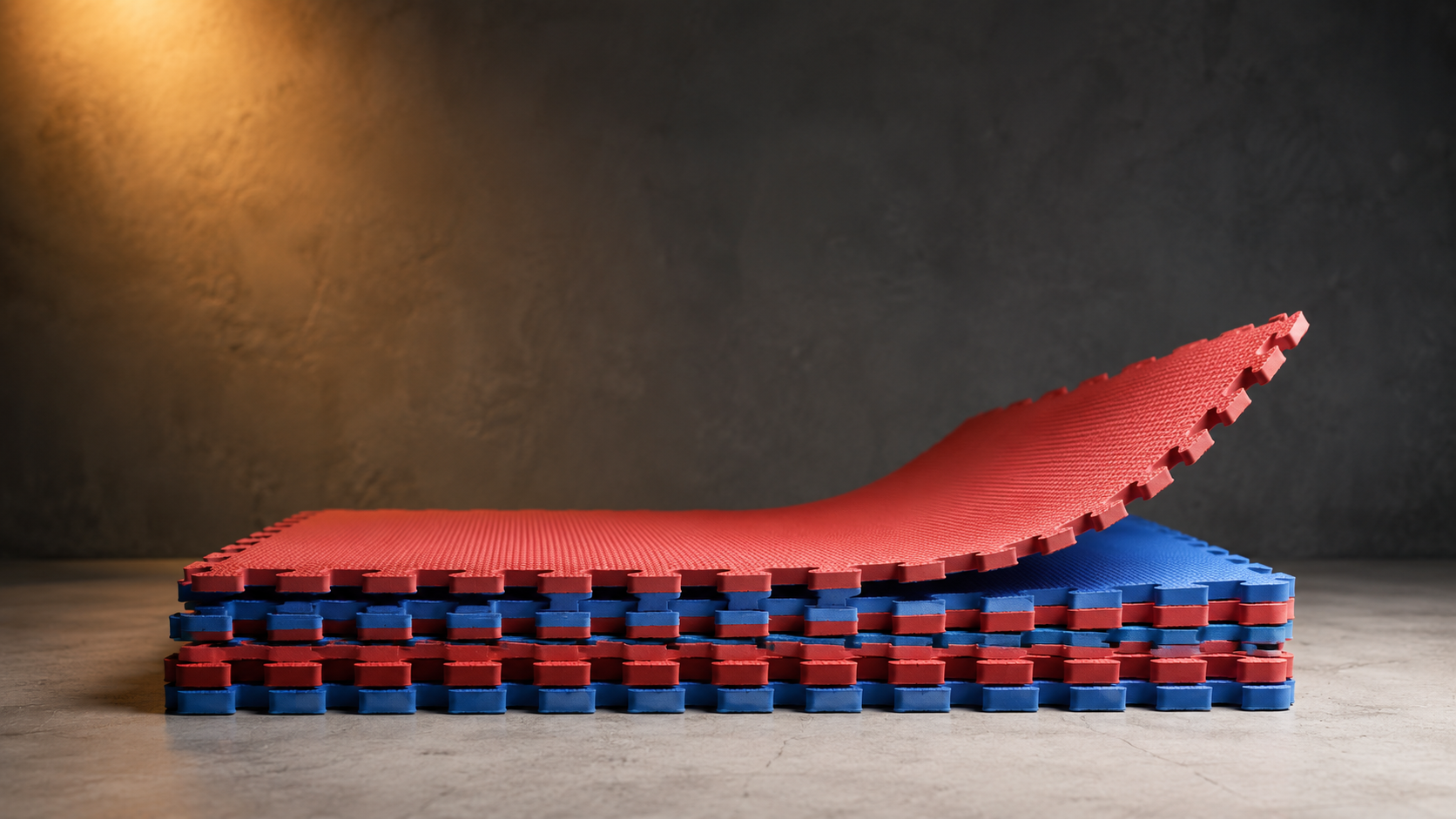
Tatami density and thickness
You are comparing tatami mats and every listing quotes a thickness in millimetres. That number on its own tells you nothing about how the mat feels when you land on it or how much it protects you. Thickness and density solve two different problems. Thickness sets how far you sink before you feel the hard floor underneath. Density, together with the foam's make-up, sets how much force it takes to compress that foam. Only read as a pair do they tell you whether a mat suits throws, ground work or fast footwork.
What tatami density and thickness mean
Density is the mass of foam in a given volume, normally expressed in kilograms per cubic metre. It is a physical quantity, not a quality grade, and it is not the same thing as hardness. A denser mat holds more material per unit of volume, but that alone does not make it firmer to the touch or better for every use.
Thickness is simply how tall the mat stands, measured in millimetres. It gives the foam a distance over which to compress, spreading the force of a fall across a longer travel before your body reaches the rigid surface below.
The central idea of this whole guide is that these are two separate properties. Thickness is the travel the foam has available; density and make-up decide how hard the foam resists as that travel is used up. Two mats of the same thickness can behave completely differently underfoot and on impact if their density or formulation differs.
Each section below takes one factor in turn: how thickness changes feel and safety, how density changes firmness, why no single number describes an impact, how to match all of it to your discipline, and what to check before you buy.
How thickness affects feel and safety
Thickness sets the depth of cushion between your body and the subfloor. A thicker mat gives the foam more room to compress, so the force of a fall spreads over a longer travel and your joints take a gentler impact. When the foam runs out of travel, the rest of the impact passes straight into the floor. That is bottoming out, and it feels like a sharp slap of concrete in the middle of an otherwise thick mat.
For wrestling and throwing, that extra depth protects shoulders, hips and spine through repeated falls. For striking and footwork, too much give gets in the way, because the foot sinks slightly on every pivot and change of direction, and stance and balance turn unsteady.
Common martial-arts tatami sits in the 20-40 mm band. Around 20-25 mm is most often offered for striking disciplines such as karate and taekwondo, where you want a stable, flat surface. Around 38-40 mm is most often offered for wrestling, BJJ and recreational judo, where you want more depth to soften a landing. Purpose-built judo mats for repeated throwing are often thicker still, around 40-50 mm, but thickness alone does not prove a mat is judo-safe. A tested judo system can be built quite differently from a simple EVA puzzle tile.
How density affects firmness
Density decides how hard or soft a mat of a given thickness feels. Within the same type of foam and the same manufacturing method, higher density usually means more stiffness and more resistance to compression. But density is not the only lever: cell size and cell-wall structure, the vinyl-acetate content of the EVA, crosslinking, fillers and any surface skin all change behaviour independently of density. That is why two mats of similar density and the same thickness can feel materially different.
In practice that means denser foam holds footwork better and stays flatter under furniture or equipment, while lower-density, softer foam cushions a fall but bottoms out sooner under heavy or concentrated loads and packs down more easily over time.
The most useful figure to pair with density is a compression measurement, not another vague label: how much force it takes to compress the foam to a stated depth, and how that resistance climbs as the foam is squeezed further. If a supplier quotes only "high density" with no compression figure, you still do not know how easily the mat will crush under feet, knees or an impact. So treat density as one clue to construction, not as the headline characteristic.
By hand you can only compare in relative terms. Press two mats of the same thickness with a thumb or heel, kneel on them, and watch how easily they compress, how quickly you feel the floor and how fast the surface springs back. That reveals obvious differences, but it gives you no figure for density, compression stress or impact attenuation.
Why no single number describes an impact
A nominal thickness, say 25 mm, does not reveal how the mat behaves under an impact. Impact attenuation depends on the whole compression behaviour of the foam, on thickness, on the energy and speed of the impact, on temperature, on construction and on the surface beneath. The same mat behaves differently on concrete and on a timber floor over joists.
EVA is also viscoelastic, so its response depends on loading rate. A mat squeezed slowly by hand behaves differently from the same mat during a fast fall, and a sample tried in a warm showroom need not feel the same in a cold garage. Exactly how temperature affects a given EVA recipe cannot be read from the word "EVA" alone; that figure has to come from the manufacturer.
It is worth separating three properties that are easily confused. Compression set is how much thickness the mat loses permanently after long or repeated time under load. Resilience is how fast it returns. Impact attenuation is how much it lowers the peak force. A foam can recover well after static pressure yet still pass on a relatively high peak impact, or it can absorb an impact well yet recover slowly and stay dented over time. "Memory", "bounce", "density" and "shock absorption" are not interchangeable terms.
Standards that actually mean something
There is no single consumer standard requiring martial-arts EVA to have a particular density in kg/m³. The standards closer to safety measure functional outcomes, not density.
For judo the relevant one is EN 12503-3, the European safety-requirements standard for judo mats. It covers shock absorption, the anti-slip properties of the base and the friction of the top surface. The EN 12503 series splits the measurements into parts: EN 12503-4 for shock absorption, EN 12503-5 for base friction, EN 12503-6 for top friction and EN 12503-7 for static stiffness. So the claim "tested to EN 12503" is incomplete until you know which part, which specimen and what result.
A few labels you will meet are worth reading narrowly. EN 12503-6 measures only top-surface friction, not density or comfort. ASTM D3575 is a materials test method for closed-cell foams, a measurement procedure rather than a martial-arts safety certificate; "tested to ASTM D3575" does not mean a mat is safe for throws. ASTM F1081 is a specification for competition wrestling mats and applies to wrestling, not automatically to BJJ, MMA, karate or judo. Finally, any shock-absorption result holds for the test conditions and does not guarantee that every real fall produces the same load.
Emboss texture, grip and mat burn
The tatami pattern on the surface is a texture, not a material property. It changes the real contact between foot or skin and the mat and can improve the sense of traction, but actual grip depends on the coefficient of friction, on contamination, moisture and wear, and on the movement itself. A pronounced texture is no proof that a mat objectively grips better.
More texture and higher friction can improve footing, but during a slide they can also tear at the skin harder. Mat burn depends on friction, texture, contact pressure, the distance and speed of the slide, moisture and the exposed skin, and it cannot be predicted from density. Grapplers usually want enough texture for control without an unnecessarily abrasive surface.
Moisture, equipment and joining tiles
Martial-arts EVA is usually closed-cell foam. Closed cells limit how much liquid soaks into the body of the material, but an assembled puzzle floor is not waterproof: water passes through the seams, the cut edges and the perimeter and becomes trapped beneath the tiles. The water resistance of the foam is not the same as vapour control over a concrete slab. In a garage or basement it is more reliable to look under the floor from time to time than to assume that a dry top surface means a dry slab.
The other weak point is concentrated loads. The narrow feet of a rack, bench or cabinet create far higher local pressure than the same weight spread across a broad plate, so EVA can give way locally even where it carries your bodyweight through a workout without trouble. EVA tatami is first of all a training surface, not a floor for heavy equipment; under racks and machines you want a rigid plate that spreads the load, or a different floor altogether. On top of that, repeated sideways loading near a seam can distort the puzzle edges or tear the interlocking tabs.
Puzzle tabs hold the tiles together without adhesive, and border strips only give a straight finished edge; they do not anchor the floor to the subfloor. So a floating puzzle field can drift, open its seams or lift its tabs during dynamic movement if the tiles are loose, the base is slippery or the perimeter is unrestrained. Temperature and storage conditions change the dimensions and feel of the foam, so a tightly fitted floor can behave differently once it has acclimated; follow the manufacturer's guidance on perimeter clearance. And one more important point: stacking two mats one on top of the other does not automatically make a safer surface, because two unsecured layers shear against each other. For more fall protection a purpose-designed, tested multilayer system beats improvised stacking.
Odour and ventilation
New foam can release volatile compounds once the packaging is opened; research on foam mats has measured compounds including formamide and ammonia. But the strength of the smell tells you neither which compound is present nor whether the product is safe. Odour is a good practical reason to air a new floor, but it is no substitute for documentation about the make-up.
Ventilation lowers the concentration of volatile compounds by diluting and carrying them away, but the rate and duration of the release depend on the recipe, the packaging, the temperature and the airflow. If you are sensitive to the smell of new foam, unpack and air the tiles in a well-ventilated space before heavy use. Washing removes surface dirt, but it does not remove the compounds coming out of the inside of the foam; cleaning and ventilation solve different problems.
Matching to your discipline and Flexadur's tatami
The right combination depends on how you train, not on a universally best spec. No single thickness and density is ideal for karate, taekwondo, BJJ, wrestling, MMA and judo at once. Anyone who trains several of these has to decide whether stability or landing protection matters more and accept the compromise, rather than chase one "best" number.
Judo, BJJ and wrestling mostly want more thickness and a moderate density, so landings are safe without the floor feeling like concrete. Karate, taekwondo and boxing footwork want a firmer, livelier surface where the foot does not sink on a fast pivot. Mixed home training usually settles on a middle choice.
Flexadur's EVA puzzle tatami mats are made for exactly that mixed use. They come in a single 25 mm thickness and one hardness, in three colour combinations, giving a dojo or a home space a consistent floor that switches between ground work and standing drills. To judge firmness, the best move is to handle a piece and test how it behaves under your usual falls and footwork.
What to check before you buy
For a better comparison than "soft versus hard" you want four separate figures: thickness in mm, density in kg/m³, a firmness or compression measurement and, where it exists, a test result for your discipline. Those four describe different parts of the performance and make it harder for a vague "high density" to stand in for real numbers. If the density is not published, ask the manufacturer for it, but do not reject a mat on that alone; a confirmed compression or sport-test result is often more telling than density by itself.
Check that the thickness suits your hardest landings and the firmness suits your most frequent movement. A 25 mm puzzle mat covers most club and home setups; demanding throwing programmes may want more depth, and halls for pure striking may prefer a firmer, flatter surface. Check how the pieces join and how the surface is finished.
Finally, work out coverage in square metres rather than from the price of a single tile. You get the area you need from the room's length and width in metres; confirm the real net coverage of one tile, because nominal dimensions, border strips and puzzle geometry all change how many pieces it takes. There is no universal waste percentage for puzzle tatami; add only the contingency your room layout justifies. Review prices both incl. and excl. VAT, so a club budget and a private buyer each see the cost in the terms that apply to them.
Key takeaways
- Thickness and density solve different problems: thickness gives the foam a travel over which to compress before you reach the floor, while density and make-up decide how much force that costs. The same thickness does not mean the same cushioning.
- Match the mat to the movement, not to the biggest number: around 20-25 mm and firmer for striking and footwork, around 38-40 mm for wrestling and BJJ, and for repeated judo throws a purpose-built, tested system (for example to EN 12503-3) rather than a choice made on thickness alone.
- Ask for four figures instead of vague labels: thickness (mm), density (kg/m³), a compression measurement and a sport test; "high density" on its own describes neither firmness nor fall protection.
- Flexadur's EVA puzzle tatami mats come in a single 25 mm thickness and one hardness, in three colour combinations; handle a piece to judge firmness, and do not use EVA as a floor for heavy equipment.
Related resources
If you are weighing tatami against rubber rolls and tiles for the same space, read how to choose gym flooring and compare thickness, seams, grip and cost across all three formats. To see the mat described here, view the EVA puzzle tatami mats with their 25 mm spec and choice of colours. For the wider range, including rubber rolls and tiles for more demanding free-weight training, visit gym and sport flooring.
Ready to choose your tatami?
Once you know the thickness and firmness your discipline needs, choosing a mat becomes simple. Compare the EVA puzzle tatami mats for martial arts and mixed home use.