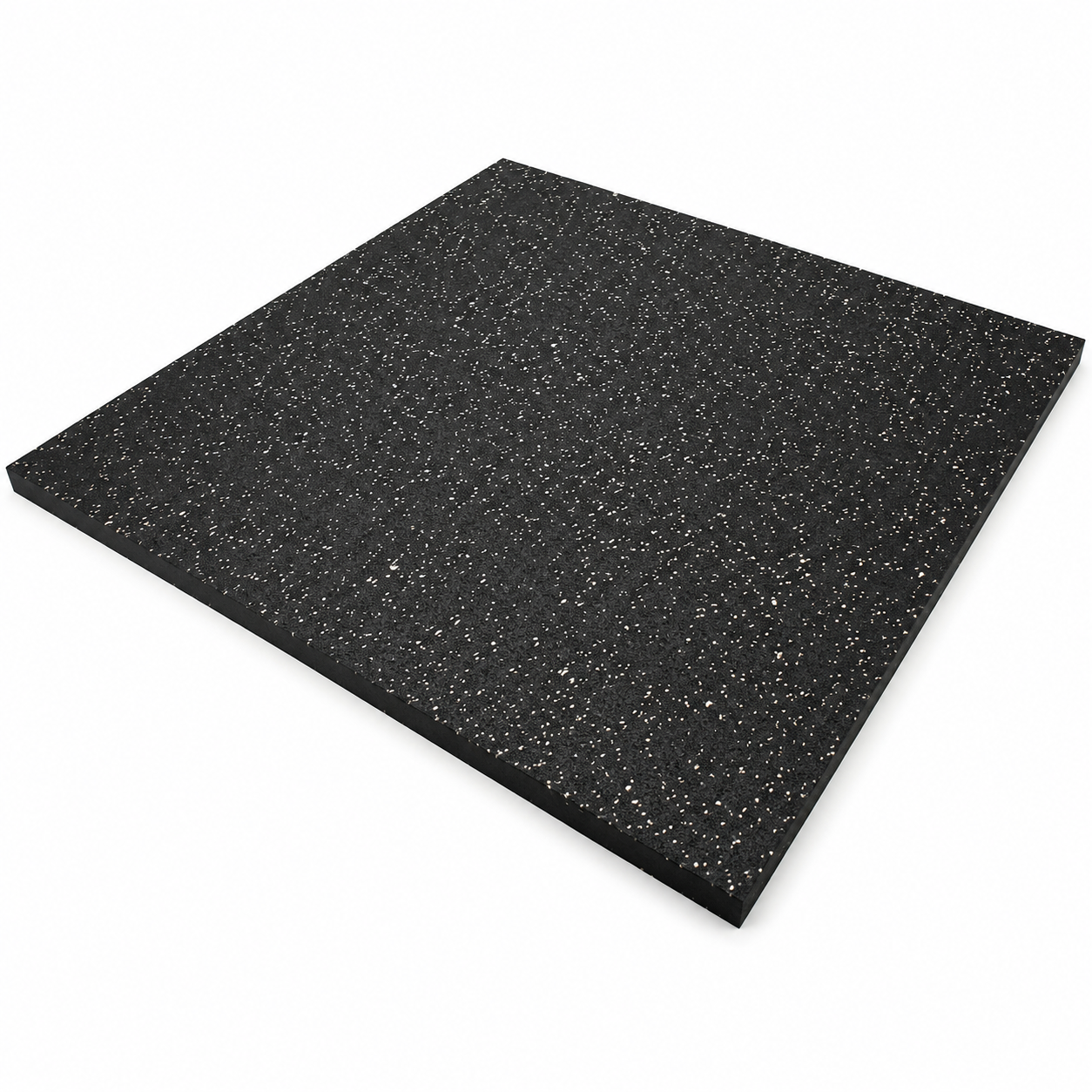
Straight-edge rubber gym tiles
Durable straight-edge rubber gym tiles for clean, butt-jointed gym floors that are easy to lay and replace. Each tile covers 1 m², so working out your coverage is simple arithmetic.
The price on this page is shown incl. VAT and excl. VAT. Most orders ship quickly from the Flexadur warehouse in Croatia.
Anchor price on 10 September 2026: €33.00
Minimum order quantity: 4 pcs
Specifications
| Dimensions | 1000 × 1000 × 15 mm |
| Material | Rubber (85% recycled SBR, 15% EPDM) |
| Colour | Black with white speckles |
| Unit of measure | Piece (= 1 m²) |
| Minimum quantity | 4 tiles |
| Brand | Flexadur |
Features and benefits
Butt-jointed straight edges
The straight edges sit flush against each other for a floor with minimal gaps. That clean line keeps dirt and sweat out of the seams and looks tidy under racks and benches.
Easy to lay and replace
Each tile is a self-contained unit, so installation is a simple grid and a repair is a one-tile swap. A worn spot under the squat rack never forces a full re-lay.
One square metre per tile
Each tile covers exactly 1 m², which turns coverage planning into simple multiplication. Measure the room, round up and order the matching number of tiles.
Black with white speckles colour
The black with white speckles colour hides scuffs, water stains and the like well. It is clear that this is a professional, purpose-built surface and not a household floor.
About straight-edge rubber gym tiles
Straight-edge rubber gym tiles from Flexadur lay edge to edge in a butt-jointed pattern that keeps gaps across the floor to a minimum. At 15 mm thick, the rubber absorbs the impact of dropped dumbbells and bars and protects the concrete underneath.
These tiles suit a permanent home gym or a commercial training zone where a clean, flat finish matters. Because each tile is a separate 1 m² piece, a damaged tile lifts out and a new one drops in without reworking the whole floor.
How to lay straight-edge rubber gym tiles
Start in one corner of a cleaned, dry subfloor and work along the longest wall. Set each tile so its straight edges butt flush against its neighbours, then continue row by row.
Cut the edge tiles to fit with a sharp utility knife and a straightedge. Because the tiles are not glued, you can lift and realign any piece during installation.
Read before you buy
Choosing thickness and tile type is easier with a plan for the whole room. The Flexadur gym guide covers density, thickness and layout. How to choose gym flooring Deciding between tiles and rolls, or between straight and interlocking edges? Two comparisons lay out the trade-offs. Rubber rolls vs rubber tiles Straight-edge vs interlocking gym tiles
Product questions
How many straight-edge rubber gym tiles do I need?
Each tile covers 1 m², so order one tile per square metre of floor and round up for cut pieces at the edges.
Do the tiles need adhesive?
Straight-edge tiles butt together and sit under their own weight, so a typical home or commercial installation needs no adhesive. Glue only the edge tiles if the floor takes heavy lateral force.
Can I replace a single damaged tile?
Yes. Because each tile is a separate piece, lift the worn tile out and drop a new one in without disturbing the rest of the floor.
You might also like

Request a quote
Fitting out an entire gym floor? Flexadur prices larger tile orders directly, without a middleman's margin.